








Most AP Automation Projects Buy a Product When They Needed a Process

Finance teams evaluate vendors for six months, sign a platform, and discover the hard part was never the software. It was the twelve invoice formats no template matches, the approval rules nobody wrote down, and the ERP that will not accept a payment file without four fields your supplier never sends.We build accounts payable automation into the system you already run. No new platform for your team to learn. No per-invoice licence that grows as you do.

Five Signs Your AP Process Is the Bottleneck

Your team keys invoices by hand

Not all of them — just the ones the OCR tool cannot read, which somehow account for most of the work and all of the errors.

Exceptions swallow the day

Straightforward invoices flow. The 20% that fail a three-way match consume the AP clerk's entire week, and nobody measures how long they sit.

You cannot answer "what does one invoice cost us?"

Without cost per invoice, cycle time, and touchless rate, there is no baseline — so there is no way to prove the automation worked.

Early-payment discounts expire unclaimed

Approval routing takes longer than the discount window, and the savings quietly leave the business every month.

The platform you bought only does part of it

It captures invoices well and then hands you a CSV, because the last mile into your ERP was never in scope.

ERP Module, Point Solution, or Custom Build: An Honest Comparison

ERP module

Point solution

Custom build

Time to live

3–9 months

6–12 weeks

6–8 weeks

Fits your exact approval rules

Only if your rules match the vendor's model

Configurable within limits

Built to your rules

Handles unusual invoice formats

Poorly

Well, up to the template limit

Extraction is trained on your actual documents

Integration with the rest of your stack

Native to that ERP, weak elsewhere

The usual failure point

The starting point, not an afterthought

Cost shape

Bundled into the ERP contract

Per invoice or per user, forever

One-time build, then hosting

Who owns it

Your ERP vendor

The platform vendor

You — code, data and models

Best when

You run one ERP, standard processes, and volume is modest

Your process is genuinely standard and you want it working next month

Your volume justifies the build, your process is not standard, or the integration is the hard part

Say the quiet part. A point solution is often the right answer. If you process a few hundred standard invoices a month against a single ERP, buy the product — you will be live sooner and cheaper, and we will tell you so on the first call. Building makes sense when the per-invoice fee starts to look like a salary, when your approval logic is genuinely yours, or when the integration everyone treats as an afterthought is actually the whole project.

Three Layers, One Working Process

[01]

Capture and Extraction

  • Main Features Card List Icon
    Extraction trained on your real documents — PDFs, scans, EDI, email bodies, supplier portals — not on a generic template library
  • Main Features Card List Icon
    Line-item level data, not just header totals, so three-way matching actually works
  • Main Features Card List Icon
    Confidence scoring on every field, with anything below threshold routed to a human instead of guessed
  • Main Features Card List Icon
    Duplicate and anomaly detection before an invoice enters the approval queue

[02]

Matching, Coding and Approval

  • Main Features Card List Icon
    Two-way and three-way match against purchase orders and goods receipts, with your tolerance rules
  • Main Features Card List Icon
    GL coding suggested from history and vendor patterns, confirmed by your team until accuracy earns autonomy
  • Main Features Card List Icon
    Approval routing that follows your delegation of authority, including the exceptions finance keeps in a spreadsheet
  • Main Features Card List Icon
    An exception queue built for the people who work it — the 20% of invoices that cause 80% of the effort

[03]

Integration, Controls and Reporting

  • Main Features Card List Icon
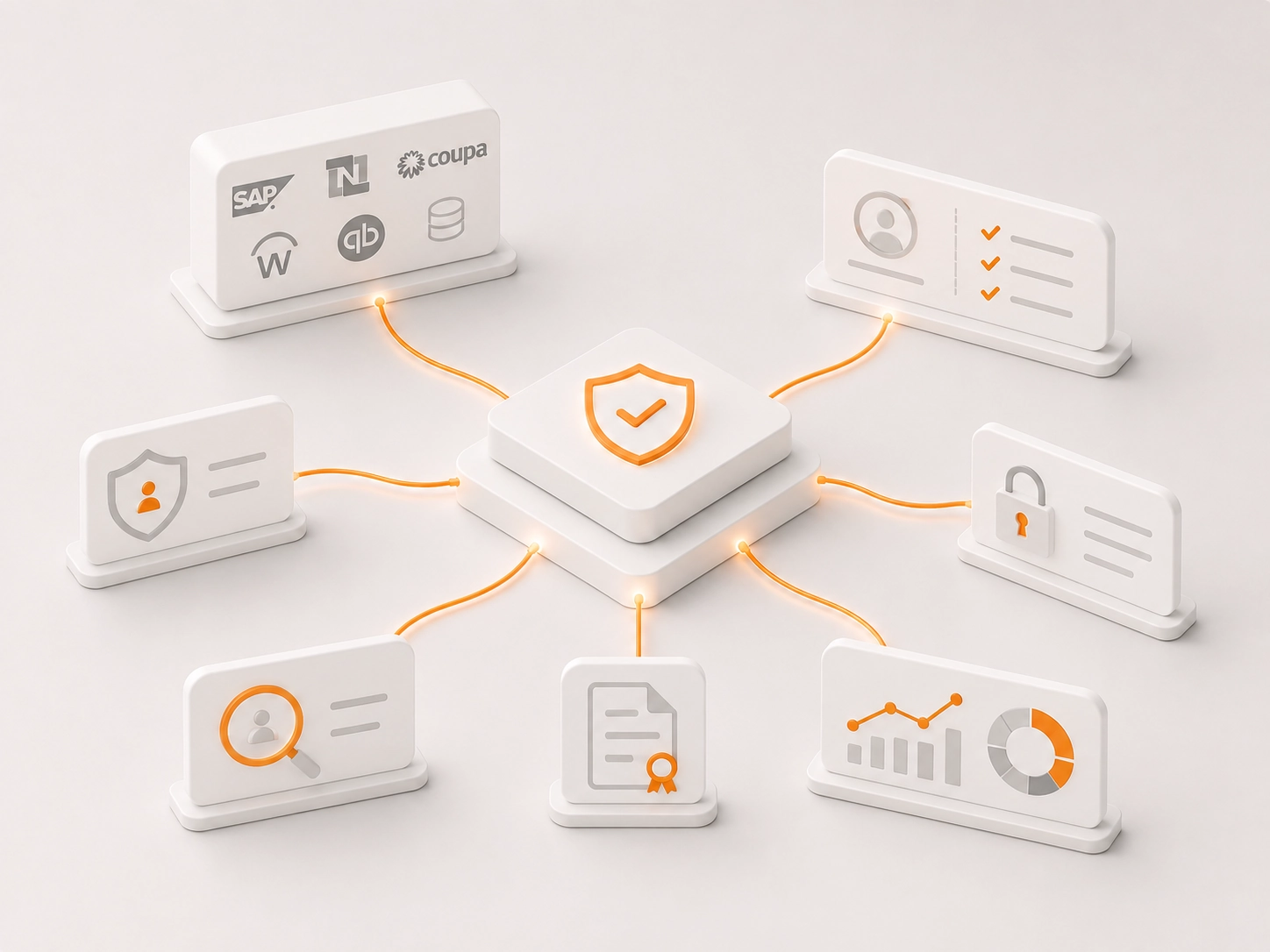
    Direct write-back to SAP, NetSuite, Coupa, Workday, QuickBooks or your legacy ERP — the step most projects underestimate
  • Main Features Card List Icon
    Segregation of duties, full audit trail, and evidence your auditors will accept
  • Main Features Card List Icon
    Fraud checks on bank-detail changes and supplier onboarding
  • Main Features Card List Icon
    A live view of cost per invoice, touchless rate, cycle time and discount capture

The Same Engine Runs the Rest of the Back Office

Document extraction and exception handling are the hard parts of AP, and they are also the hard parts of everything next to it. Once the layer exists, extending it is a fraction of the original build.

Accounts receivable and order-to-cash

remittance matching, cash application, collections prioritisation.

View Case Study
arrow

Order processing

sales orders arriving as PDFs and emails, turned into clean records.

View Case Study
arrow

Contract review

obligation extraction, clause comparison, renewal and approval tracking.

View Case Study
arrow

Expense and travel

receipt extraction and policy checks against your rules.

View Case Study
arrow

Financial reporting and FP&A

recurring reports assembled from source systems instead of by hand.

View Case Study
arrow

What to Measure Before You Automate Anything

We establish these as a baseline before the build starts, so the result is measured rather than claimed.

Cost per invoice — fully loaded, including the exception handling everyone forgets to count

Touchless rate — the share of invoices that reach payment with no human intervention

Cycle time — receipt to approval, and approval to payment, tracked separately

Exception rate and exception ageing — how many fail, and how long they sit

Duplicate and overpayment rate — the number that pays for the project on its own

Early-payment discount capture — offered versus actually taken

First-pass match rate — invoices that match a PO without anyone touching them

Two Illustrative Scenarios

These are illustrative scenarios, not client case studies. They describe engagements of the kind we scope and build, using volumes and constraints typical of the companies we work with. Baseline figures are scenario assumptions. Outcome figures are modelled from those assumptions, not measured client results. Published client results appear on our case studies page

Scenario A — Wholesale distributor: 4,000 invoices a month, twelve layouts, one exception queue

― The situation

A distributor processes around 4,000 supplier invoices a month against purchase orders in NetSuite. Roughly 40% arrive as PDF attachments in layouts that change without warning; the rest come through EDI and a supplier portal. An existing OCR tool reads header totals reliably and line items almost never, so three-way matching is done by hand. Two AP clerks spend most of their week on the 20% of invoices that fail a match, and nobody can say how long an exception has been sitting.

― What we would build

Line-item extraction trained on the client's own historical invoices rather than a generic template set, with per-field confidence scoring so low-confidence values are routed to a person instead of guessed. Three-way match against the PO and goods receipt with the client's own tolerance rules. An exception queue designed around how the clerks actually work — grouped by cause, aged, and prioritised by discount deadline. Write-back into NetSuite through its REST API, with a full audit trail.

― How we would measure it

Cost per invoice and touchless rate established as a baseline in week one, before anything is built. Field-level extraction accuracy benchmarked on a sample of the client's worst invoices and reported before the build is committed. Post-launch, the same metrics tracked weekly, with autonomy extended vendor by vendor only as measured accuracy allows.

― The realistic shape of the result

In a scenario like this the gain is concentrated in two places: line-item capture removes most of the manual keying, and a properly designed exception queue removes most of the waiting. Header-only OCR typically leaves straight-through processing in the low tens of percent; line-item extraction with confidence routing is what moves it. The discount capture is often the line finance notices first, because approval delay — not disagreement — is usually why early-payment discounts expire.

― Timeline

Six weeks: one week process review and baseline, one week extraction benchmark, two weeks prototype on the highest-volume vendor group, two weeks integration, controls and handover.

Scenario B — Professional services firm: 900 non-PO invoices, and a per-invoice bill that kept growing

― The situation

A 300-person services firm processes about 900 invoices a month, almost none of them backed by a purchase order. Every invoice has to be coded to a project and a cost centre, then routed through a delegation of authority that lives partly in the ERP and partly in a spreadsheet the finance director maintains. The firm already bought an AP platform. It captures documents well, charges per invoice and per user, and hands finance a file that someone still has to reconcile into the ERP by hand. The bill has grown with headcount for three years.

― What we would build

We would keep the capture tool — it works — and rebuild only the three layers that stalled. GL and project coding suggested from 24 months of the firm's own coding history, surfaced with confidence and confirmed by the approver rather than applied silently. Approval routing that encodes the real delegation of authority, including the exceptions currently held in the spreadsheet. Direct write-back to the ERP, which is the step the platform never covered.

― How we would measure it

Coding suggestion accuracy against the firm's historical decisions, measured before launch on invoices the model has not seen. Approval cycle time by band. And a straightforward three-year cost comparison: current per-invoice and per-seat fees at projected headcount, against build plus hosting.

― Where it goes next

The extraction and matching layer built for payables is the same layer receivables needs. In a firm like this the natural second phase is remittance matching and cash application — a fraction of the original build, because the hard part already exists.

― Timeline

Five weeks, shorter than Scenario A because capture is already solved and there is no three-way match to model.

Our procurement RFP case is the closest published work  See how we productionize document AI

Who We Are

[ TEAM ]

We build custom AI systems for companies that have decided the off-the-shelf answer does not fit. Every engagement gets a named task force: a solutions architect, an AI/ML engineer, an integration specialist and a security engineer. You own the system, the code and the intellectual property. No per-invoice fee, no seat licence, no rented black box.

We work with organizations across the United States.

 The Production Stack

Document extraction and vision models

LLMs with private deployment

Agentic frameworks and vector databases

Core backend: Python, FastAPI, PostgreSQL

Workflow and approval UI: self-hosted low-code

Native integrations: SAP, Coupa, NetSuite, Workday, QuickBooks, Shopify Plus.

Frequently asked questions

Home Integrations Icon
Home Integrations Main Icon

Find Out Whether You Should Build This — or Just Buy It

Home Integrations Icon
You will speak with a solutions architect, not a sales representative. Bring a month of invoices, including the ones nothing can read. You will leave with a baseline and a straight answer, whether or not the answer is us.