


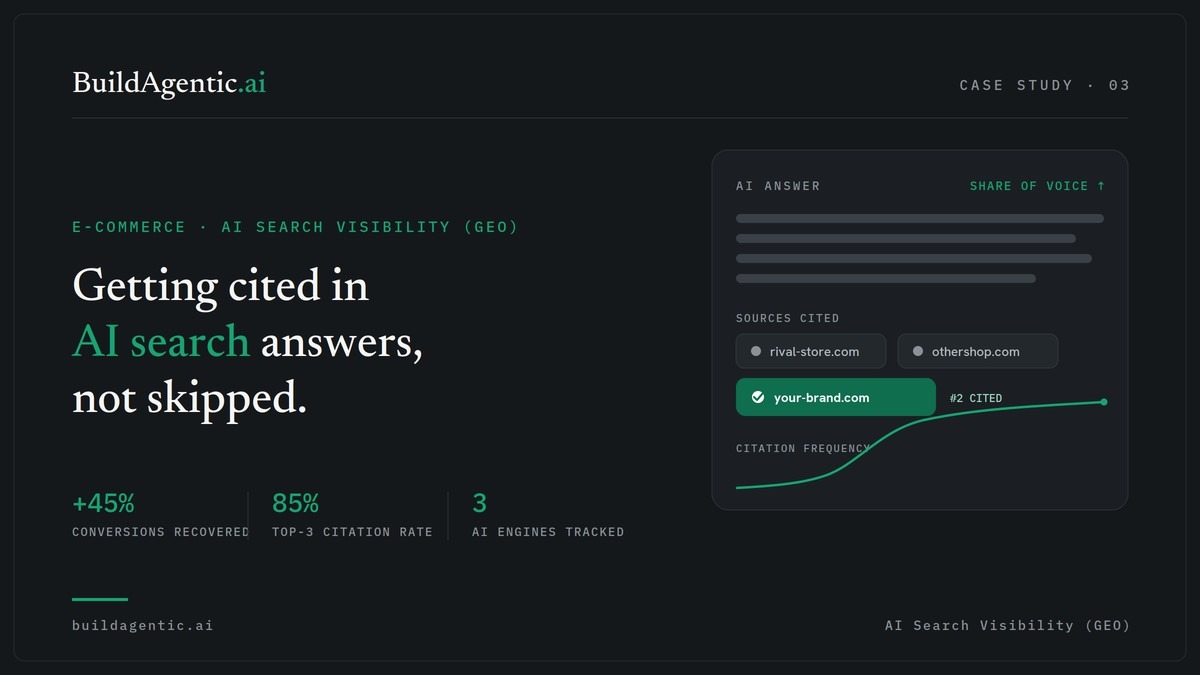
E-Commerce · AI Search Visibility (GEO)
AI Search Tracking in Action: Recovering 45% of Lost Organic Conversions
We built an AI search tracking system for an established e-commerce brand that was losing high-intent traffic to AI answers recommending competitors instead. We made the brand visible again where buyers now ask first — inside ChatGPT, Perplexity, and Google AI Overviews — and re-engineered its product data to get cited.
- +45% recovery in direct organic conversions
- Top-3 citations on 85% of high-intent queries
- 3 AI engines monitored on a daily schedule (ChatGPT, Perplexity, Gemini)
- 3 weeks from kickoff to live tracking
The Client
An established mid-market e-commerce brand (name withheld under NDA) with a deep catalog and a decade of strong traditional SEO. For years, ranking on Google's first page reliably drove its highest-intent buyers. In 2026, that stopped being enough.
This is a textbook BuildAgentic engagement: a capable operator blindsided by a paradigm shift, needing a focused system fast — not a year-long agency retainer or an enterprise platform built for someone else.
The Challenge
The brand's analytics showed a clear, alarming line: high-intent organic traffic down roughly 40%, with no algorithm penalty to explain it. Buyers who used to search, click, and compare were increasingly getting an answer straight from Google's AI Overviews or ChatGPT — and a recommendation — without ever reaching the brand's site. The cause was structural, in three layers:
Buyers were asking AI first. Customers who used to browse and compare now read a generated answer and acted on it. If the brand wasn't in that answer, it didn't exist.
The brand was invisible in those answers. When AI engines described the category, they cited competitors. The brand's deep product knowledge simply wasn't being surfaced or quoted.
There was no way to even see it. Traditional rank trackers measure blue-link positions. They said nothing about whether the brand appeared inside a generative answer, how often, or against whom. The team was flying blind on the exact surface that was draining their traffic.
The brand wasn't losing because its products were worse. It was losing because the new front page of search couldn't see it.
Why Off-the-Shelf Tools Failed
The team's existing SEO stack was built for a world of ten blue links. Two limits made it useless here:
- Wrong unit of measurement. Rank trackers count positions in a results page. AI search rewards citations inside an answer — a different mechanic entirely. The old tools couldn't measure the thing that now mattered.
- No competitor visibility in generative answers. There was no reliable, niche-specific way to see which rivals AI engines were recommending, how consistently, or why — let alone track it as it changed day to day.
Generic "AI SEO" checklists were everywhere, but none connected real-time measurement to a concrete plan for getting the brand's own data cited. That gap is what we built into one system.
Our Approach
We ran BuildAgentic's standard five-step pipeline, compressed into three weeks.
1. Audit & opportunity mapping. We defined the set of high-intent queries the brand needed to win, then measured exactly where it stood inside AI answers today — and which competitors were cited in its place.
2. Data source connection. We built monitoring across the engines that mattered (ChatGPT, Perplexity, Google AI Overviews), with secure pipelines to capture how each described the category and who it cited.
3. 14-day resilient prototype. Using context-aware extraction (Firecrawl, Jina AI), we shipped a citation-tracking dashboard for the priority query set — turning an invisible problem into a daily, measurable share-of-voice number for the first time.
4. Content engineering deployment. We re-engineered the brand's deep product data into machine-readable form — structured facts, consistent entities, and answer-shaped content — in line with Google's own guidance on generative AI features, so AI engines could parse, trust, and quote it.
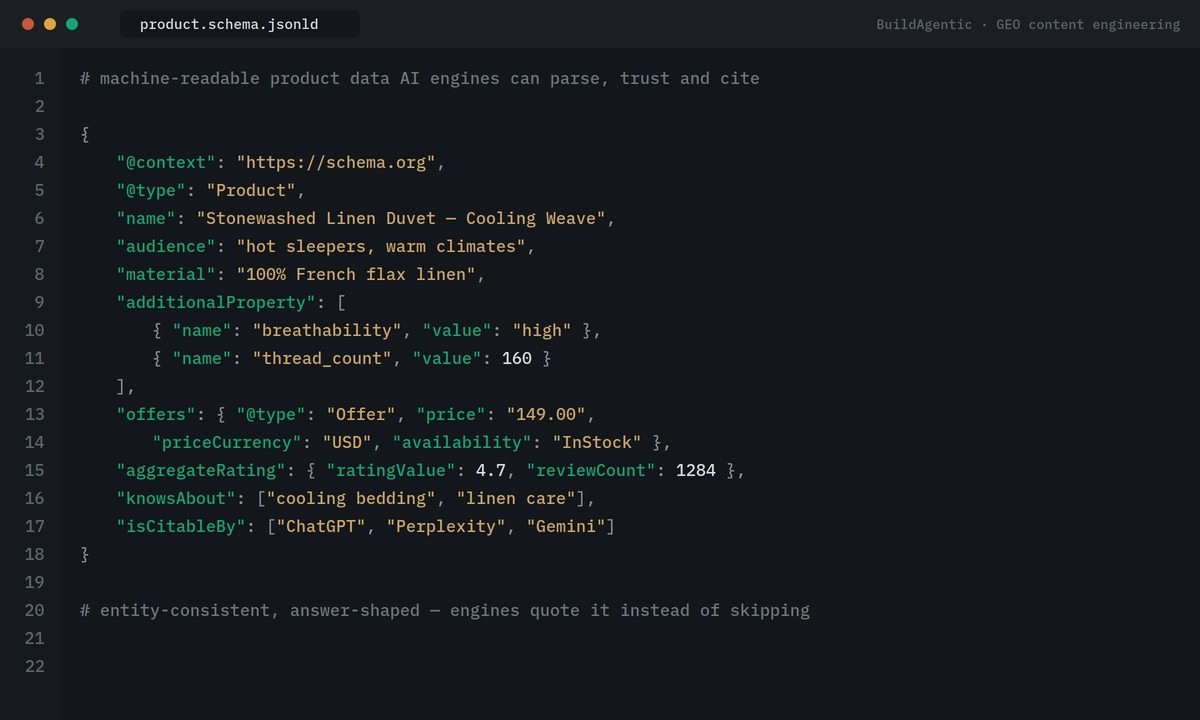
5. Live tracking & iteration. We switched on continuous monitoring and tuned the content framework against what actually moved citations, with the brand's team retaining full visibility and control over every change.
What We Built
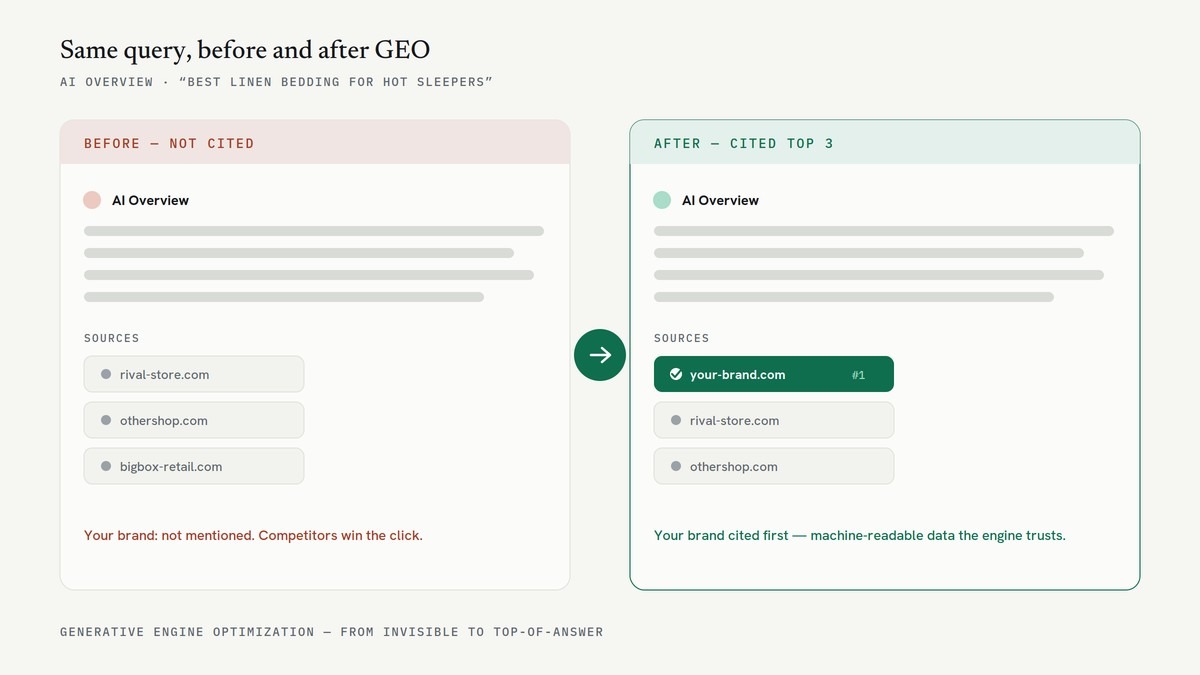
Scheduled AI search tracking. A custom pipeline measures the brand's citation frequency and share of voice across ChatGPT, Perplexity, and Google AI Overviews on a daily cadence — converting a vague sense of "we're disappearing" into a measurable, query-by-query metric.
Competitor citation tracking. The system maps which rivals each engine recommends for the brand's priority queries and how that shifts over time, exposing exactly where the brand was being displaced and where the openings were.
Generative content engineering. We rebuilt the brand's product and category data to be machine-readable — structured, entity-consistent, and shaped like the answers engines actually quote — turning a deep but invisible catalog into citable source material.
Monitoring dashboard. A single view tracks visibility, citations, and competitor share, refreshed on each monitoring run. The data and the content framework stay entirely inside the client's environment — they own the system and the results it produces.
The Results
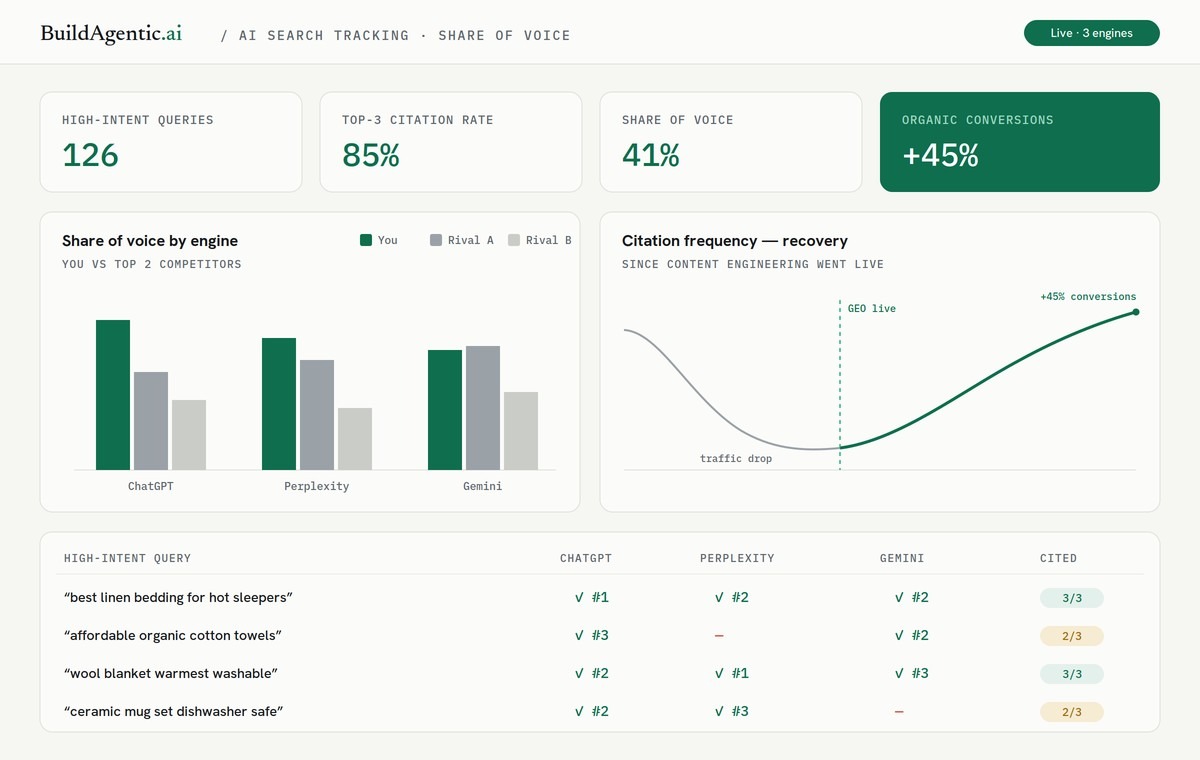
- Top-three citations on 85% of high-intent queries. The brand went from largely absent to consistently quoted across the searches that drive purchase intent.
- +45% recovery in direct organic conversions. Restoring visibility inside AI answers brought back nearly half of the conversions the brand had been quietly losing.
- Daily visibility, finally. The team can now see where it stands in generative search day to day — and react before a competitor locks in a citation.
- A durable capability. The tracking system and content framework remain in place, so the brand defends its AI-search position continuously instead of rediscovering the problem next quarter.
How the Tracking Actually Works (and What to Know)
"AI search tracking" sounds like magic, so here's the honest mechanics — including the parts most vendors leave out:
- It's scheduled polling, not a live feed. No one gets a real-time stream of what ChatGPT or Google AI Overviews say. The system re-runs your priority query set on a daily schedule and records what each engine answers and cites. "Live" in this context means "checked every day," not "streaming by the second" — and we say so plainly.
- We prefer official channels, and respect the rules. Where an engine offers an API or a sanctioned way to query it, we use it. This matters because automated, large-scale scraping of Google's search results runs against Google's Terms of Service, and AI Overviews sit inside Google Search. A tool that quietly mass-scrapes the SERP carries technical fragility (it breaks when the page changes) and compliance risk. We scope query volume, favor permitted methods, and keep your domain out of grey-area automation — because the last thing a growing brand needs is its visibility tool creating a liability.
- The 85% and +45%, measured. The 85% top-3 citation rate is the share of the brand's defined high-intent query set where it appeared in the top three cited sources on the most recent monitoring run (engines vary run to run, so this is a snapshot, not a permanent guarantee). The +45% is the recovery in direct organic conversions attributed to non-paid landings over the post-launch window versus the pre-decline baseline, from the brand's own analytics.
- The honest caveat. Attribution in generative search is genuinely hard — a buyer might see an AI citation, then return via a branded search later. We report the correlation we can measure and flag what we can't cleanly isolate. If a vendor promises you precise, real-time, guaranteed AI-search numbers, be skeptical — the responsible version of this is rigorous, scheduled, and openly caveated.
Timeline
Phase
Days
Audit & query opportunity mapping
Days 1–3
Engine monitoring connection
Days 3–6
Resilient tracking prototype
Days 6–12
Content engineering deployment
Days 12–18
Live tracking & iteration
Days 18–21
Total: 3 weeks, kickoff to live tracking.
Tech Used
Frontier LLMs (OpenAI, Anthropic) · AI search monitoring (ChatGPT, Perplexity, Google AI Overviews) · Firecrawl · Jina AI · Python (FastAPI) · PostgreSQL · Retool · Private-cloud deployment (SOC 2)
Watching organic traffic fall with no idea why?
Get a free AI-search visibility audit — we'll show you exactly where ChatGPT, Perplexity, and Google AI Overviews mention you, and where they mention your competitors instead.
Get a Free AI-Search Visibility Audit
