


Competitor Price Tracking Software in Action: Recovering 12% of Lost Margin
We built custom competitor price tracking software for a growing online retailer that was losing margin every week to a scraper that kept breaking and a pricing process running days behind the market. The result was a self-healing system that reads rival catalogs like a human — and reprices on the retailer's terms.
- +12% retained margin on tracked categories
- ~99% monitoring uptime (from weekly breakages to near-zero)
- <1 hour repricing latency (down from 2–4 days)
- 6 weeks from kickoff to live deployment
How We Measured It
So the numbers above mean something, here's how they were produced:
- The +12% retained margin. "Tracked categories" is a defined subset of SKUs we instrumented; the figure is blended gross margin on those SKUs over the first full quarter live, compared against the same quarter the prior year, pulled from the retailer's own analytics — not our dashboard. It isn't a total-business margin, and we don't claim it is.
- Latency, uptime, accuracy. Repricing latency and monitoring uptime are logged by the system itself; "~98% match accuracy" was validated by a human reviewing a random sample of auto-matched product pairs, not asserted by the model itself.
- The "~20 hours/week saved" is the merchandising team's own before/after estimate of manual checking time, so treat it as a self-reported operational figure, not a stopwatch study.
- On compliance. Price tracking reads publicly listed competitor prices, but automated scraping still has to respect each site's terms and rate limits. We scope request volume, favor permitted methods, and build in self-healing extraction precisely so the system stays robust without hammering anyone's site — a tool that gets your IP blocked isn't an asset.
The Client
A mid-market home & lifestyle e-commerce retailer (name withheld under NDA) selling across Shopify Plus and Amazon. Roughly 4,200 active SKUs, a lean two-person merchandising team, and a competitive set of about 15 rival storefronts whose prices moved constantly.
This is exactly the band BuildAgentic is built for — past the point where manual checks scale, but nowhere near ready to absorb a six-figure enterprise pricing suite. With online sales now around a sixth of all U.S. retail, per the U.S. Census Bureau, even a few points of margin across a catalog this size add up fast.
The Challenge
The retailer competed in categories where a competitor's flash discount could erase a product's margin overnight. Three problems compounded:
Their scraper broke almost weekly. A standard, HTML-bound price tracker crashed every time a competitor restyled a product page. Each break meant blind spots of one to several days on the exact SKUs that mattered most.
Pricing ran days behind the market. Between breakages, gaps, and manual verification, the team reacted to competitor moves with a 2–4 day lag — long enough to lose the sale or hold a price too high while a rival undercut them.
The team was drowning in manual checks. Two merchandisers spent roughly 20 hours a week opening competitor tabs by hand to confirm prices the scraper missed or mismatched — time stolen from actual merchandising.
The cumulative effect was a quiet, continuous margin leak: discounting too late, matching the wrong rival SKU, or holding stale prices on fast-moving items.
Why Off-the-Shelf Tools Failed
The retailer had already tried boxed price-tracking tools. Two structural limits kept biting:
- Rigid HTML parsing. Legacy scrapers map to a page's structure. Change the structure, break the scraper. Competitor redesigns are routine — so breakage was routine.
- Naïve product matching. Off-the-shelf matching keys on titles and SKUs. When a rival listed the same item under a different name or model code, the tool either missed it or matched the wrong product — feeding bad data into pricing decisions.
An enterprise pricing platform could have solved parts of this, but at a price tag and multi-month rollout that made no sense for a 4,200-SKU catalog and a two-person team.
Our Approach
We ran BuildAgentic's standard five-step pipeline, end to end in six weeks.
1. Audit & opportunity mapping. We mapped the current pricing workflow, quantified where the scraper failed, and ranked SKUs by margin contribution — so the system protected the highest-stakes products first.
2. Storefront & API connection. We built secure pipelines into Shopify Plus and Amazon Seller Central to read live catalog and price data and to safely stage automated updates.
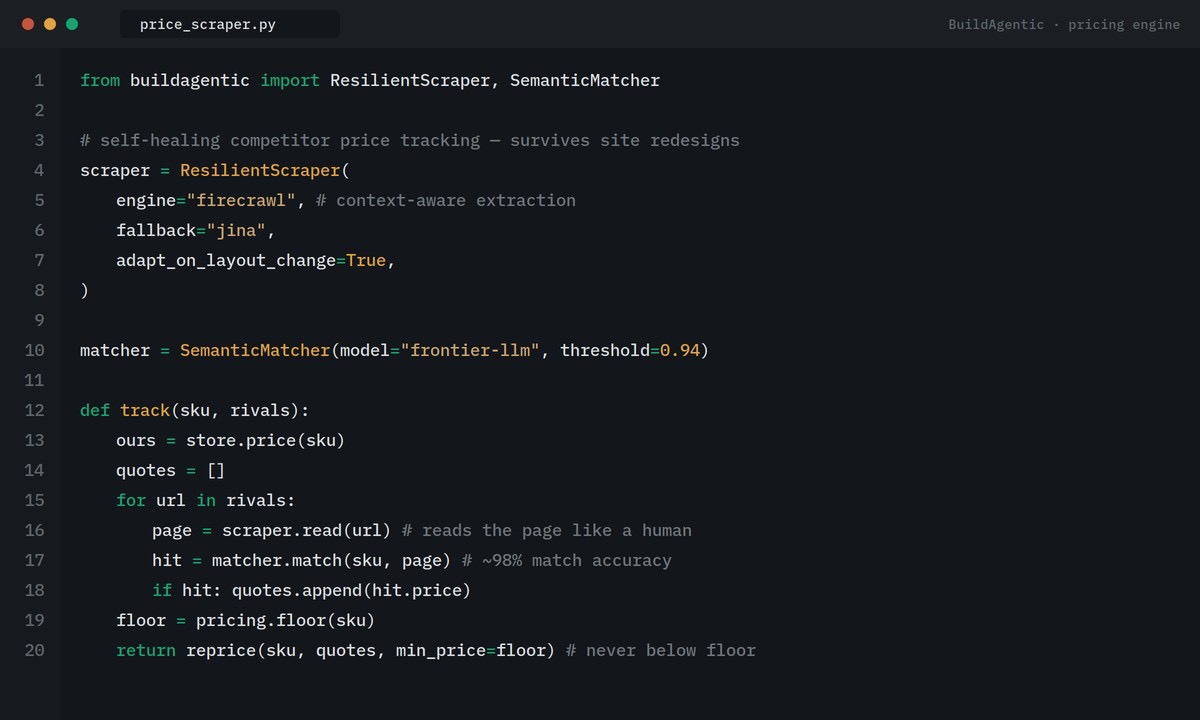
3. 14-day resilient prototype. Using context-aware extraction (Firecrawl, Jina AI), we shipped a working proof of concept that read competitor pages by meaning rather than markup — surviving the layout changes that broke the old tool.
4. Private-cloud deployment. We scaled the validated system inside the client's private cloud perimeter, with rotating proxy management to prevent blocking, fully SOC 2 compliant.
5. Live, guarded activation. We switched on automated repricing only behind hard guardrails — price floors, category rules, and an approval dashboard — so the team kept full control before handing the engine autonomy.
What We Built
Semantic + visual product matching. Instead of keying on SKUs, our models match products by meaning and appearance, so the same item is recognized across rivals even under different titles, model codes, or bundles. This pushed competitor-match accuracy to roughly 98%, cutting the false matches that had been poisoning pricing decisions.
Self-healing extraction. The engine reads competitor pages contextually. When a competitor changes layout, it adapts instead of crashing — which is what took monitoring uptime to about 99%.
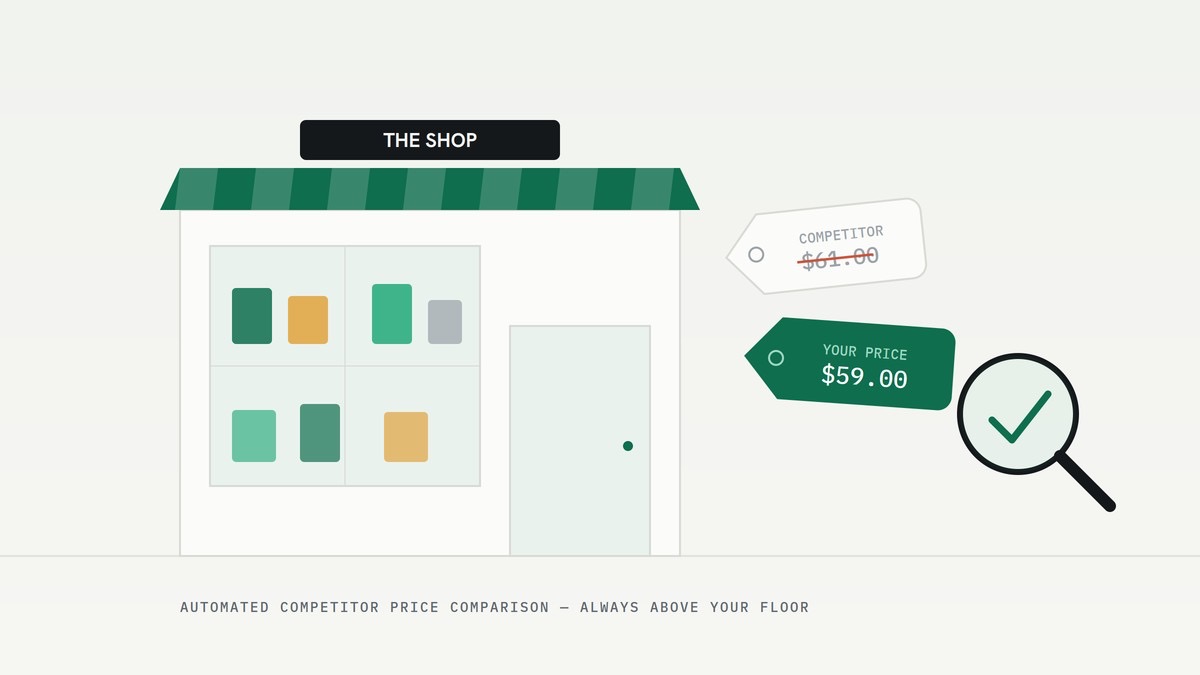
Rule-based repricing engine. Wired directly into the storefront, the engine compares competitor prices continuously and applies the retailer's own rules — never dropping below a defined price floor — so repricing is automatic but never reckless.
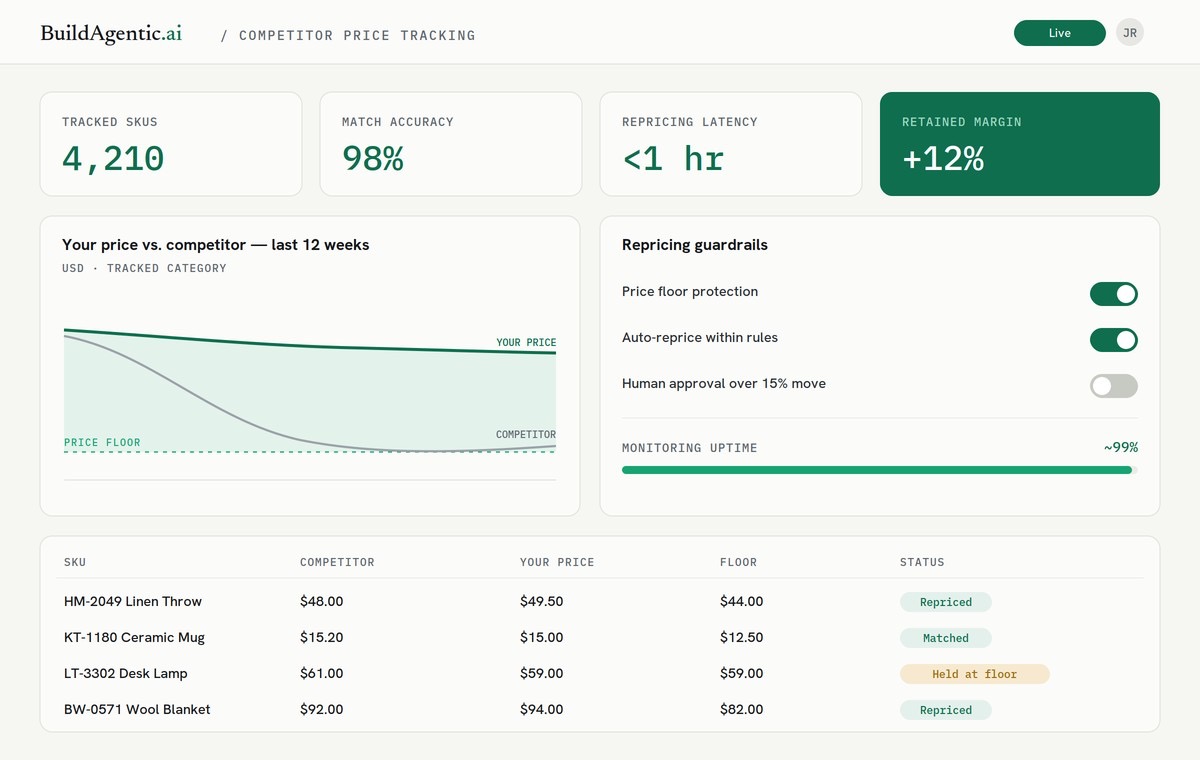
Control dashboard. A clean interface gives the team live visibility, floor settings, and an approval queue. Data and logic stay entirely inside the client's environment — they own the data, the prompts, and the code.
The Results
- +12% retained margin on the tracked categories, by ending late reactions and mismatched comparisons.
- Repricing latency cut from 2–4 days to under an hour, so the retailer now moves with the market instead of behind it.
- Monitoring uptime ~99%, eliminating the weekly blind spots that came with the old scraper.
- ~20 hours/week of manual price checking eliminated, returning the merchandising team to actual merchandising.
- ~98% product-match accuracy, turning competitor data from a liability into a reliable input.
The system paid back its build cost within the first quarter of operation through recovered margin alone.
Timeline
Audit & opportunity mapping: Week 1
Storefront & API connection: Weeks 1–2
Resilient prototype (PoC): Weeks 2–4
Private-cloud scale deployment: Weeks 4–5
Guarded activation & handover: Week 6
Total: 6 weeks, kickoff to live.
Tech Used
Frontier LLMs (OpenAI, Anthropic) · Firecrawl · Jina AI · Python (FastAPI) · PostgreSQL · Retool · Private-cloud deployment (SOC 2)
