

Custom Field Service Mobility Platform — FSM Mobile App for Dispatch, Inspections and Field Reporting
We build field service custom software for US repair, maintenance, logistics and inspection companies that still run field work through group chats, paper forms and spreadsheets. The delivery is a mobile field service management app — an offline-first service technician app for incident capture with photo, geolocation and status, real-time dispatch and route assignment, digital safety inspection forms, and management reporting that assembles itself from field data instead of being chased down by

Field Service Custom Software Built Around How Your Crews Actually Work
We design and ship a mobile field service management app that replaces group chats, paper forms and Excel in the field — offline-capable incident capture, live dispatch, digital inspection forms, and management reporting that builds itself. Hybrid delivery: classic engineering where reliability matters, AI and low-code where speed matters.
Book a 30-minute field operations review · See how we scope your FSM mobile app
The Triggers
If your field operation runs on screenshots, callbacks and end-of-week spreadsheets, these are the symptoms you already recognize.
The blind zone between "on the way" and "job closed"
Dispatch sends the crew out and then goes quiet. Status lives in a WhatsApp thread, a voicemail and someone's memory. Nobody in the office can answer "where is that job right now" without three phone calls, and by the time the truth surfaces, the customer already escalated.
Paper forms and Excel that never become data
Inspection sheets get photographed, timesheets get typed in twice, job notes get lost in a chat scroll. Your business captures more field data than ever and still can't make a decision with it — because none of it lands in a queryable system on the day it was collected.
Off-the-shelf FSM that fits somebody else's process
The subscription looked reasonable until you priced the per-seat model across a growing crew, discovered your inspection workflow doesn't exist in the product, and realized the "customization" is a settings toggle. Generic field service management software for small business teams forces you to reshape the operation around the tool instead of the other way around.
Disconnected systems and slow invoicing
The field app doesn't talk to the ERP, the ERP doesn't talk to accounting, and job costing is reconstructed manually days later. Parts usage, labor hours and completed work sit in separate silos, so invoices go out late and margin per job is a guess.
A stalled or failed implementation you're still paying for
A previous rollout consumed budget and never reached adoption — technicians quietly went back to texting. Legacy ERP add-ons stay transactional and outdated, mobile devices sit unmanaged, and the software investment shows no return anyone can point to.
Solutions
1. Offline-first FSM mobile app for technicians
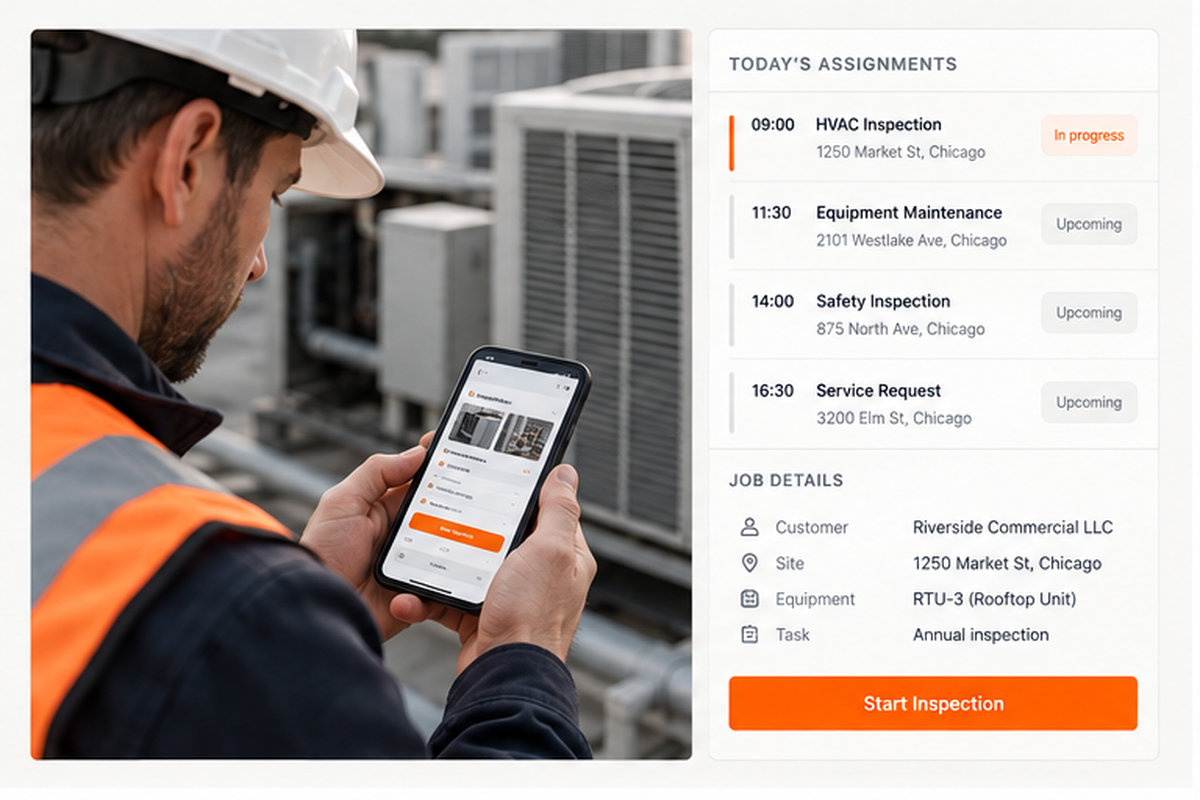
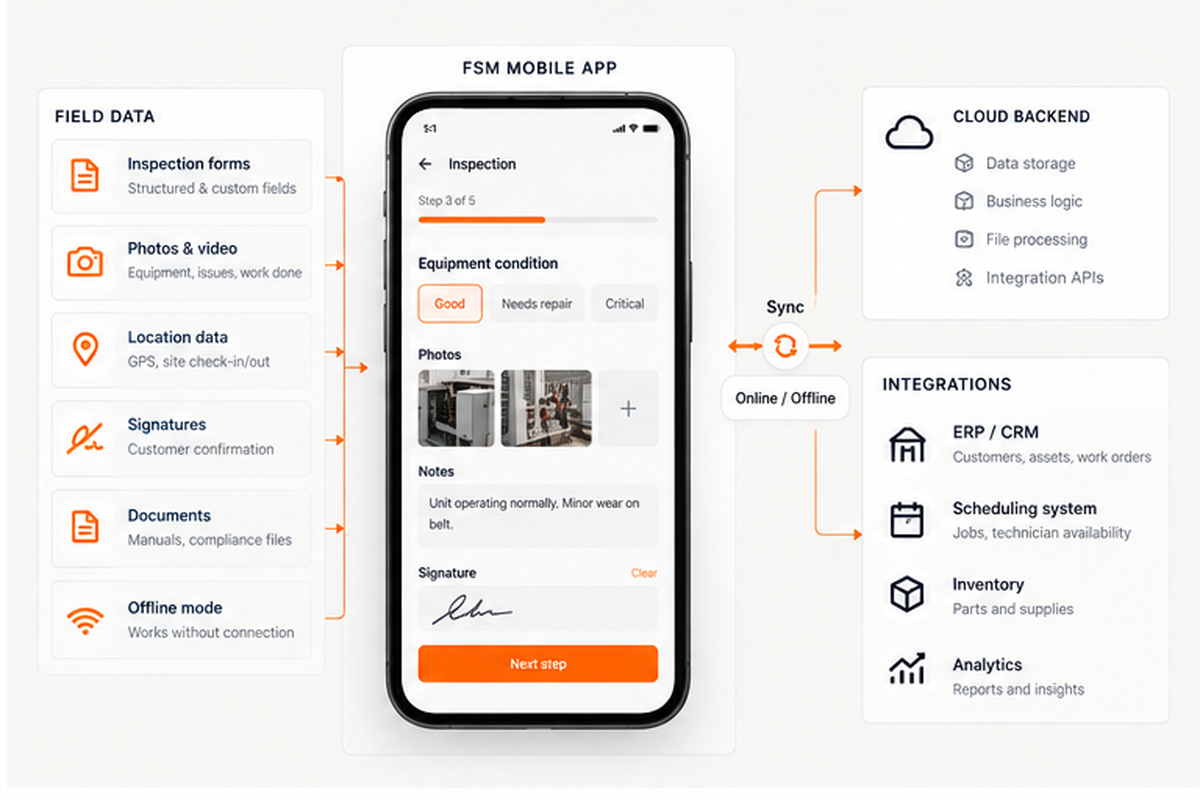
We build the service technician app your crews open first thing in the morning: assigned jobs, asset history from prior visits, photo and video capture with geolocation and timestamp, parts used, signature capture, and status transitions that survive a basement with no signal and sync when the truck reaches coverage. Apps for service technicians live or die on speed of data entry, so the UI is designed around gloved hands, glare and thirty-second interactions. We ship it as a field service agent app template configured to your job types, then extend it per trade, region or contract.
Tech capability: React Native / Flutter offline sync, conflict-resolution data layer, device-level media compression and geotagging
2. Real-time dispatch, scheduling and route assignment
Dispatchers reassign work mid-route, see live crew position and ETA, and push job changes to the field without a phone call. We build online field service scheduling software logic around your real constraints — skills, certifications, service windows, territory, parts on the van — and layer AI ranking that proposes the next best technician for an emergency call. Time and attendance is captured from the same app, so labor hours flow into job costing instead of a paper timesheet. See AI dispatch software development and AI route optimization software development for how we approach the scheduling and routing core.
Tech capability: constraint-based scheduling engine, geospatial routing APIs, WebSocket push and escalation rules
3. Digital safety inspection forms and field reporting
If you're asking which app helps create digital safety inspection forms for your specific compliance regime, the honest answer for most operators is: not an off-the-shelf one. We build a mobile forms engine with conditional logic, required photo evidence, pass/fail scoring, offline completion and automatic PDF generation for the customer and the regulator. The same engine powers mobile incident reporting from the field — a technician logs a fault, attaches evidence, and the escalation chain fires immediately instead of at Friday's debrief.
Tech capability: dynamic form schema builder, rules-driven validation, automated PDF/report generation and e-signature
4. Integration with the ERP, CRM and accounting you already run
The field app is only worth building if it closes the loop with the back office. We implement and integrate against NetSuite FSM and NetSuite field service records, Dynamics 365 Field Service and field service CRM Dynamics 365 objects, Salesforce, QuickBooks, HubSpot, and ecommerce sources including Shopify, Magento, WooCommerce and Amazon where parts and warranty flows depend on them. Where the ERP is legacy and transactional, we handle migration and data cleanup rather than bolting a mobile layer onto broken records. We also run vendor-neutral software selection when buying beats building for a given module.
Tech capability: REST/GraphQL and SuiteTalk integrations, iPaaS middleware, idempotent sync with audit trails
5. AI agents and workflow automation inside the operation
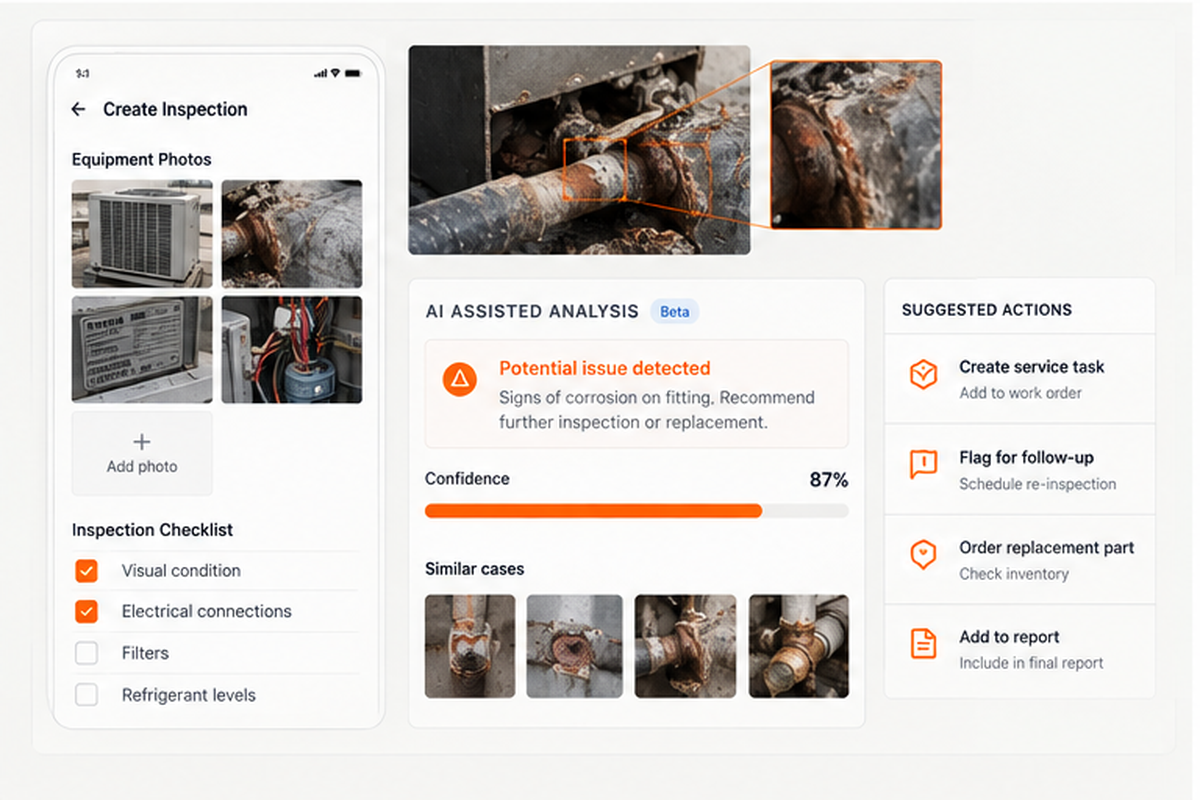
We put AI where it removes clerical work, not where it makes a demo look clever: agents that draft the job summary and customer-facing report from technician notes and photos, triage inbound service requests by urgency, flag inspection anomalies against prior visits to the same asset, and auto-raise parts orders when stock on the van drops below threshold. Copilot-style assistants let a dispatcher or ops director query the operation in plain language. Automation design starts at AI automation consulting and parts flows connect through AI procurement automation.
Tech capability: LLM agent orchestration, computer vision on inspection media, RAG over asset and job history
6. Management dashboards, job costing and invoicing
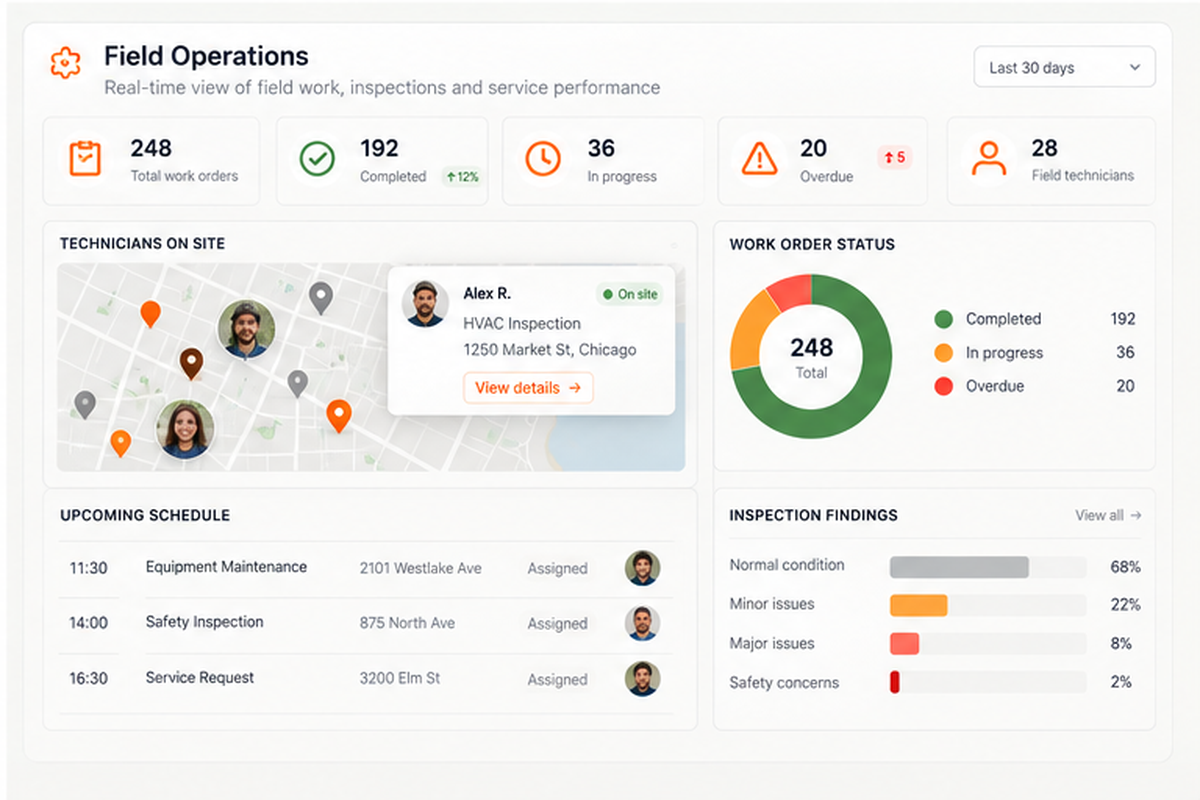
Operations directors get first-time fix rate, jobs per tech per day, SLA breaches, overtime, and cost-to-serve by contract — assembled from field data automatically, with no one exporting spreadsheets. Completed work triggers invoicing, and we build in-field payment capture where your model calls for it. Reporting sits on a proper warehouse rather than live queries against the transactional system, so dashboards stay fast as volume grows; more on that approach at AI analytics automation.
Tech capability: cloud data warehouse (Snowflake/BigQuery), Power BI and Looker dashboards, payment gateway integration
7. Rescue, hardening and managed run
When a prior rollout failed, we start with a health check: what the data looks like, why technicians abandoned it, what can be salvaged. From there we rebuild the weak layer instead of restarting from zero, migrate cloud or hybrid infrastructure, run QA and device testing across the actual handsets your crews carry, and take the system into managed support after go-live with SLAs on incident response.
Tech capability: implementation health check, automated regression and device-farm testing, MDM and observability tooling
Our USP
We choose the build method per module, not per company. The dispatch engine, offline sync and integration layer get classic, hard-tested software engineering because a lost job record or a double-booked crew costs real money; internal admin screens, form builders and back-office tooling get low-code and AI-assisted development because speed there is worth more than bespoke craftsmanship. That hybrid technology approach is why a field operations app from us lands at the cost and timeline of a configured product with the fit of custom software.
How We Work
1. Field operations review (no charge)
A 30-minute working session with your COO, dispatcher and one technician. We map the current path of a job from intake to invoice, mark every handoff that runs on chat, paper or memory, and identify which of those is costing the most hours per week.
2. Discovery and process design
We ride along or shadow dispatch, then define job types, statuses, form logic, escalation rules and role permissions. Output is a clickable prototype of the FSM mobile app plus a fixed scope, cost band and delivery timeline — decided before a line of production code is written.
3. MVP in the field within weeks
One crew, one job type, real customers. We ship the offline mobile app, dispatch board and core integration first, using our MVP practice at AI MVP development, so you see field service mobility working in production instead of in a slide deck.
4. Rollout with adoption built in
Technician training in the language of the job, dispatcher runbooks, side-by-side operation during transition, and a feedback loop in the first weeks where we ship changes based on what crews actually complain about. Adoption is a delivery metric for us, not a client responsibility we hand over.
5. Run, measure and extend
Managed support with monitoring and SLAs, then a quarterly roadmap: additional trades, subcontractor access, customer portal, deeper AI agents, expanded analytics. The platform grows with the crew count rather than being replaced at the next tier.
Tech Stack
Mobile
React Native, Flutter, Swift, Kotlin
Backend & Cloud
Node.js, Python (FastAPI), PostgreSQL + PostGIS, AWS and Azure (hybrid cloud where on-prem ERP requires it)
AI & Machine Learning
OpenAI and Anthropic models, LangGraph agent orchestration, vector search (pgvector, Pinecone), computer vision for inspection media
Data, BI & Reporting
Snowflake, BigQuery, dbt, Power BI, Looker Studio
Integrations & Business Systems
NetSuite (SuiteTalk/SuiteScript), Dynamics 365 Field Service, Salesforce Field Service, QuickBooks, HubSpot, Shopify / Magento / WooCommerce / Amazon connectors
Geospatial & Scheduling
Mapbox, Google Maps Platform, OR-Tools routing, custom constraint solvers
DevOps, QA & Device Management
Docker, Kubernetes, GitHub Actions, Detox/Appium device testing, MDM tooling, Sentry and Datadog observability
The Team
Solution architect (field operations)
Owns the domain model — jobs, assets, visits, forms, crews — and decides which layer is engineered classically and which is delivered with AI-assisted or low-code tooling.
Mobile engineers (offline-first)
Build the technician-facing app around sync reliability, battery, connectivity gaps and one-handed use in the field.
Integration and data engineer
Connects the app to NetSuite, Dynamics 365, accounting and ecommerce systems, and stands up the warehouse that management dashboards read from.
AI engineer
Ships the agents and vision models: job summarization, request triage, anomaly detection on inspection photos, natural-language querying of operational data.
Delivery lead / change manager
Runs the rollout, technician training and post-launch feedback loop, and reports progress against the scope and timeline agreed at discovery.
FAQ
What does this cost, and how do you price it?
We price by scope, fixed per phase, after discovery — not by seat. Most field operations start with a defined MVP phase covering the mobile app, dispatch board and one core integration, followed by phased extensions. You get a cost band and timeline in writing before build starts, and we work inside it; scope changes are quoted separately rather than absorbed silently into an overrun. The initial field operations review is free, and discovery is a paid, deliverable-producing phase whose output (prototype, spec, estimate) is yours whether or not you continue with us.
We looked at free field service management software for small business — why build custom?
Free and low-cost tools are a reasonable start, and we'll tell you when one is enough. They stop working when your inspection forms don't fit their template, when per-technician pricing outgrows a build, when the data can't reach your ERP, or when your competitive advantage is precisely the process the generic tool won't model. Custom becomes the cheaper option at the point where you're paying subscriptions and still running Excel alongside them.
Will it integrate with what we already run?
Yes — that's usually the hardest and most valuable part of the project. We integrate with NetSuite field service records and NetSuite FSM, Dynamics 365 Field Service and Dynamics field service CRM objects, Salesforce, QuickBooks, HubSpot, and ecommerce platforms including Shopify, Magento, WooCommerce and Amazon. Where an ERP has no usable API, we work through supported middleware or a controlled data layer, with sync audited end to end.
Is our data secure if we use AI in the workflow?
Field photos, customer addresses and job records never go into public model training. We run enterprise API endpoints with zero-retention terms, keep sensitive fields redacted or tokenized before they reach a model, host data in your cloud tenancy or region as required, and enforce role-based access plus full audit logging. For clients with strict requirements we run smaller models in a private environment instead of a public API.
Our last implementation failed. Can that be recovered, and will migration break anything?
This is a normal starting point for us. We begin with a health check on the existing system and data, then rebuild the layer that broke — usually adoption, integration or data quality — rather than starting from scratch and repeating the write-off. Migrations run as parallel operation with reconciliation before cutover, so the old process stays available until the new one is proven. Examples of how we structure operational rebuilds are at case studies.
Will technicians actually use it, and what support do we get after launch?
Adoption is designed in: the app is built with your crews in discovery, tested on their actual devices, and rolled out with hands-on training rather than a PDF. After go-live we run managed support with monitoring, SLAs on incident response, and a quarterly roadmap. The architecture scales from a single crew to multi-region operations without a replatform — same codebase, more roles, territories and integrations.
Footer CTA
Bring us the messiest part of your field process — the chat thread, the paper checklist, the spreadsheet nobody trusts — and we'll show you what it looks like as a working mobile field service management app. Thirty minutes, no obligation, and you leave with a scoped path either way.
Book your field operations review →
