


E-Commerce · Fraud Prevention
Return Fraud Detection in Action: How a DTC Brand Stopped 38% of Abusive Returns
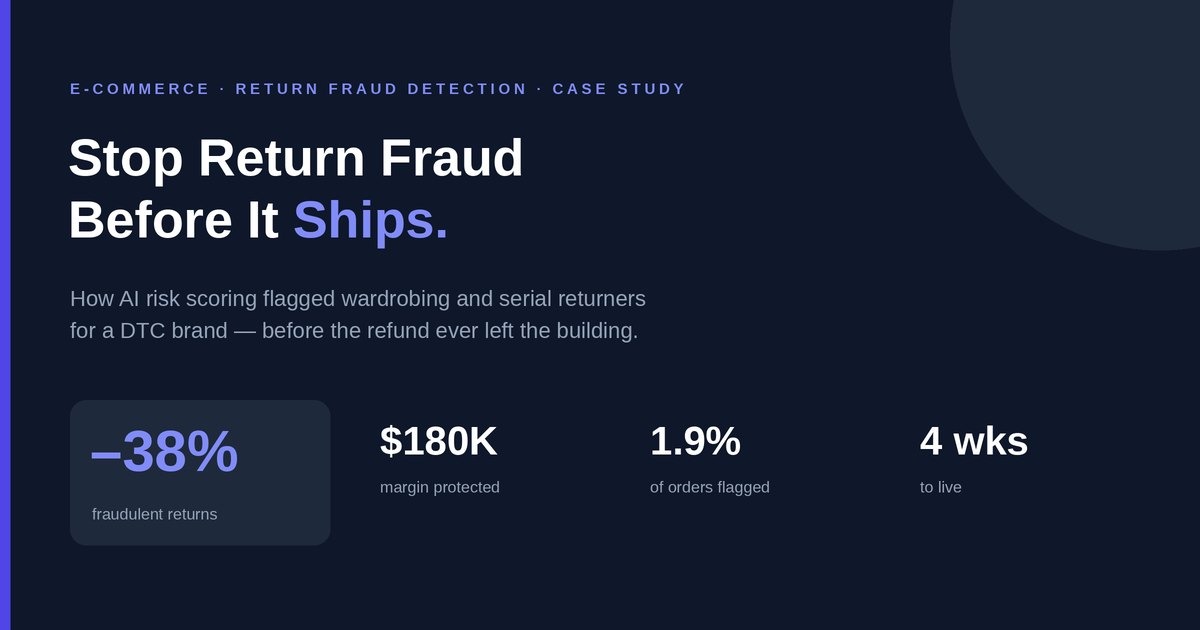
To make return fraud detection work before the money left the building, we built behavioral risk scoring for a DTC retailer — AI that scores every return-eligible order, flags wardrobing and serial returners, and routes only the risky ones to review. Over six months, fraudulent returns fell 38% and the brand protected an estimated $180K in margin.
- −38% fraudulent returns over 6 months
- $180K margin protected
- 1.9% of orders flagged for review (the rest flow through untouched)
- 4 weeks from kickoff to live
These figures illustrate a representative engagement (anonymized under NDA) — not a single audited client result. The methodology is below; we share real, client-specific numbers on a call.
How We Measured It
So the numbers above mean something; here's how they were produced:
- The −38%. Measured as the count of returns later confirmed as abuse (wardrobing, serial-return patterns, policy violations) over the six months after launch, indexed against the six-month pre-launch baseline.
- The $180K. The margin protected on returns the system prevented or recovered — product cost + return shipping + restocking + write-down — using the client's own cost inputs.
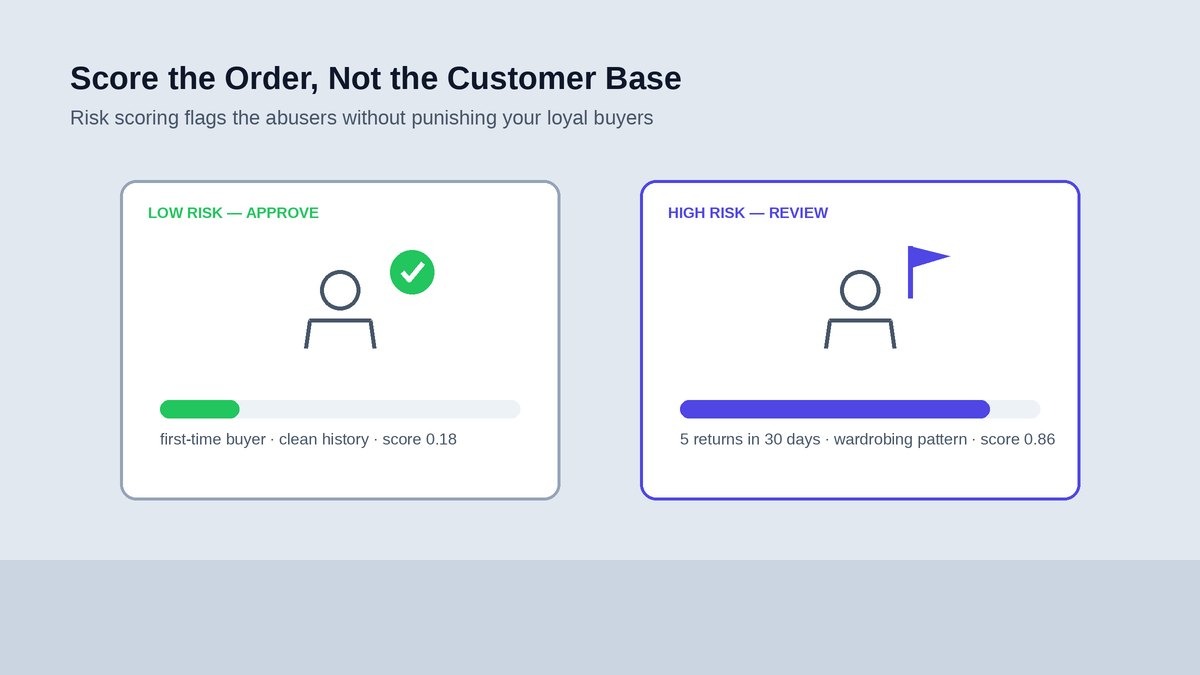
- The 1.9% flagged. Share of orders the model routed to human review; the other ~98% were approved automatically, so good customers saw no added friction.
- On honesty. The figures on this page illustrate a representative engagement — anonymized under NDA — not a single audited client statistic. We publish the exact methodology so you can judge the approach, and we'll walk you through real, client-specific numbers on a call.
The Client
A direct-to-consumer apparel & footwear brand (name withheld under NDA), selling on Shopify with high exposure to "wardrobing" — customers buying, wearing once, and returning. Order volume had grown past the point where a small CX team could eyeball suspicious returns by hand.
It's the profile we work with most — too big to police returns manually, too lean to absorb a six-figure fraud-platform contract built for enterprise retail.
The Challenge
The brand was losing margin to a small group of customers gaming a generous return policy. Three problems compounded:
Wardrobing was invisible until too late. Worn-once returns came back unsellable, but nothing flagged the pattern before the refund was approved.
Serial returners flew under the radar. A handful of customers drove a disproportionate share of returns, yet each order looked fine in isolation — the abuse only showed up across their history.
Blanket policy changes punished everyone. Tightening the return window or restocking fees would have hurt the loyal majority and dented conversion, without actually stopping the abusers.
The cumulative effect was a steady margin leak the brand could feel in its numbers but couldn't pin to specific orders.
Why Off-the-Shelf Tools Failed
The brand had tried the obvious fixes. Two structural limits kept biting:
- Returns apps don't score risk. Standard Shopify returns tools process refunds and print labels. They have no model of customer behavior, so they can't tell an abuser from a first-time buyer.
- Rigid blocklists over- and under-fire. Static "ban this email" rules miss anyone who switches accounts and wrongly punish legitimate customers — and enterprise fraud platforms that do this well are priced and scoped for brands many times larger.
What the team actually needed was a risk score per order, tuned to their own catalog and thresholds — not a blunt policy or a bloated platform.
Our Approach
We ran BuildAgentic's standard five-step pipeline, end to end in about four weeks.
1. Audit & opportunity mapping. We analyzed historical returns to quantify how much margin abuse was costing and which signals (return velocity, category, refund ratio) actually predicted it.
2. Storefront & data connection. We built secure pipelines into Shopify and the helpdesk to read order history, customer behavior, and return outcomes, and to stage risk decisions safely.
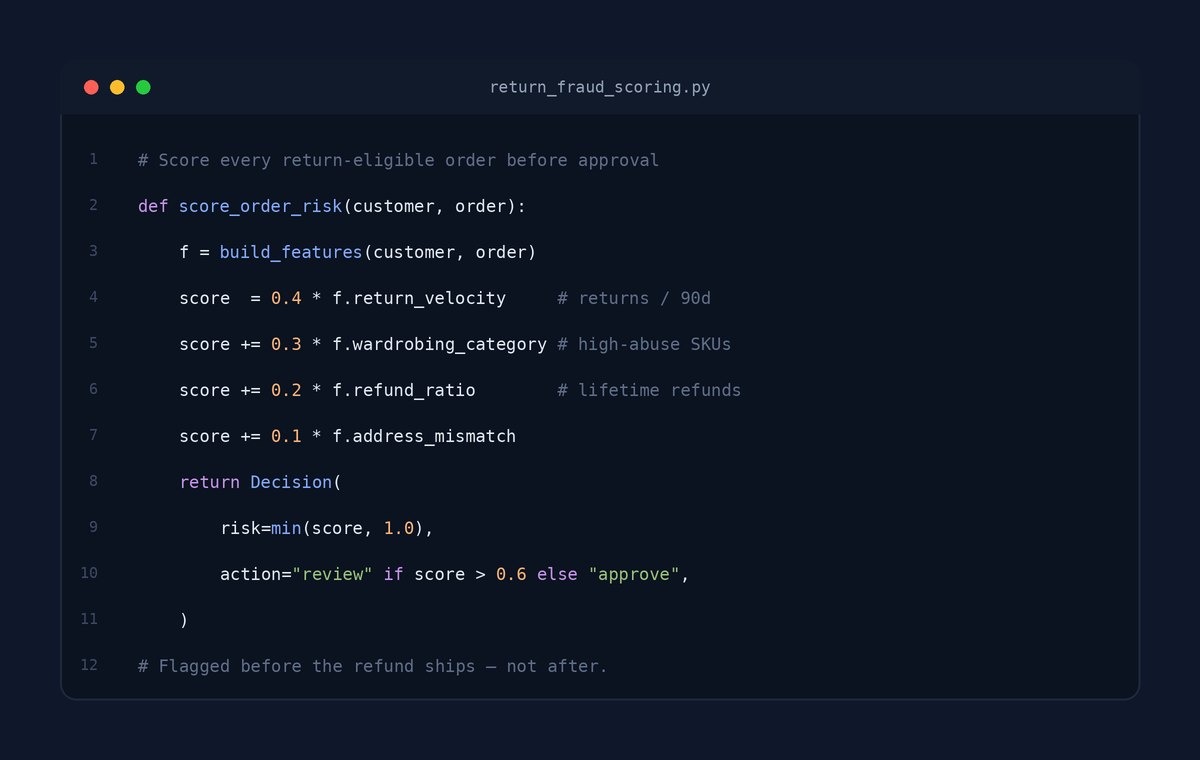
3. 14-day resilient prototype. We stood up a behavioral risk-scoring model that grades every return-eligible order on weighted signals — explainable, and tuned to the client's own abuse patterns.
4. Private-cloud deployment. We scaled the validated system inside the client's private cloud perimeter, fully SOC 2 compliant, so customer and order data never left their control.
5. Live, guarded activation. The system flags and routes — it never auto-blocks. Every high-risk order goes to a human reviewer with the reasons attached, so the team keeps full control and avoids false positives on good customers.
What We Built
Behavioral risk-scoring engine. Instead of static blocklists, the system scores each order on return velocity, wardrobing-prone categories, lifetime refund ratio, and address signals — and explains every score. It uses behavioral signals only — never protected attributes — and every score is logged and auditable, with a human confirming each flag.
Wardrobing & serial-returner detection. Pattern logic surfaces worn-once and high-frequency abuse across a customer's history, not just the order in front of you.
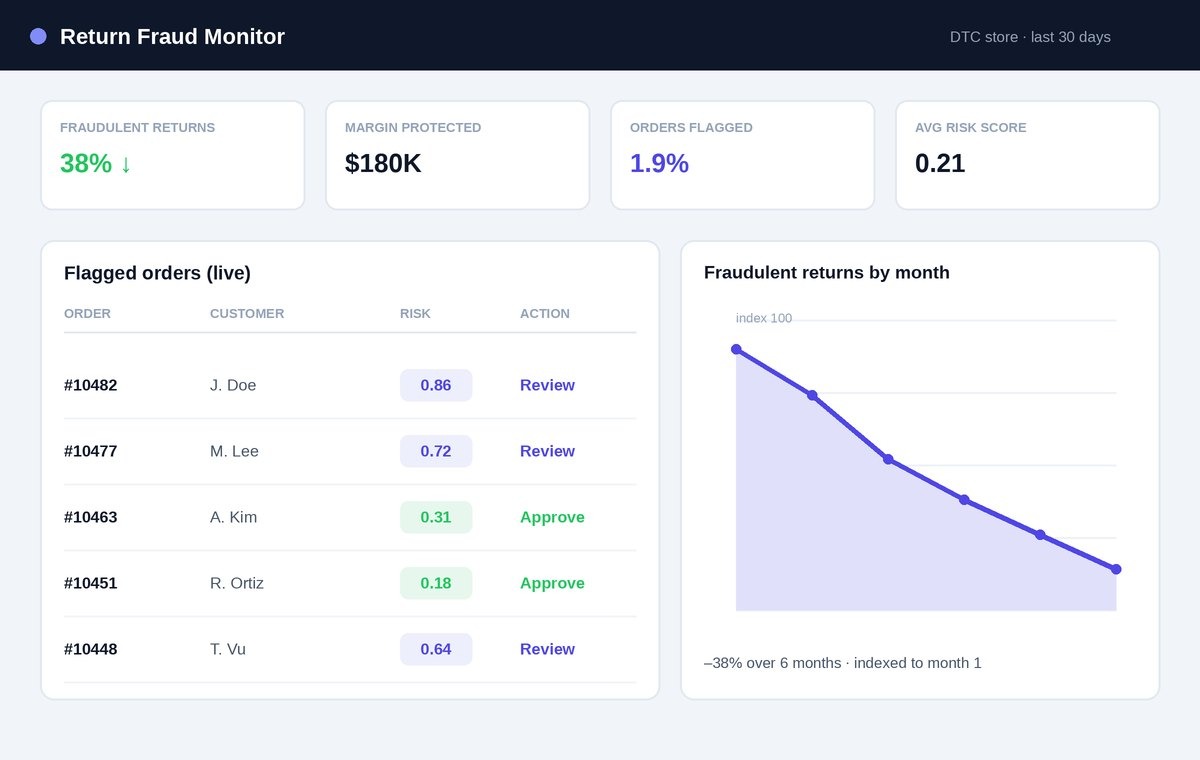
Review dashboard. A clean queue shows flagged orders, their risk scores, and the contributing factors — so reviewers act in seconds and good orders flow through untouched.
The Results
- −38% fraudulent returns over six months, by catching abuse before the refund was approved.
- $180K in margin protected, from prevented and recovered abusive returns.
- Only ~1.9% of orders flagged for review, so the loyal majority saw zero added friction.
- Serial returners and wardrobing surfaced automatically, instead of slipping through order by order.
- Reviewers act in seconds, with the risk reasons attached to every flagged order.
By the client's accounting, the protected margin covered the build cost inside the first quarter.
Timeline
Phase
Weeks
Audit & opportunity mapping
Week 1
Storefront & data connection
Weeks 1–2
Resilient risk-scoring prototype (PoC)
Weeks 2–3
Private-cloud deployment
Week 3
Guarded activation & handover
Week 4
Total: ~4 weeks, kickoff to live.
Tech Used
Frontier LLMs (OpenAI, Anthropic) · Python (FastAPI) · PostgreSQL · secure low-code review dashboards
Quietly losing margin to wardrobing and serial returns?
Get a free return-fraud audit — we'll score a sample of your past returns and show you exactly how much abuse is hiding in them.
FAQ
Q: How does AI return fraud detection avoid blocking good customers? A: It scores risk on behavior, not identity, and routes only a small share of orders to human review — it never auto-blocks. The large majority of customers are approved automatically, so legitimate buyers see no added friction.
Q: What signals flag a likely abusive return? A: Return velocity, lifetime refund ratio, wardrobing-prone categories, and order or address anomalies — combined into an explainable score. A human confirms every flag before any action, and the model never uses protected attributes.
Related case studies
- Returns Reduction — cutting size-driven returns in apparel
- Reverse Logistics Software — true cost of returns per SKU
- Service: AI Returns Management & Analytics
